


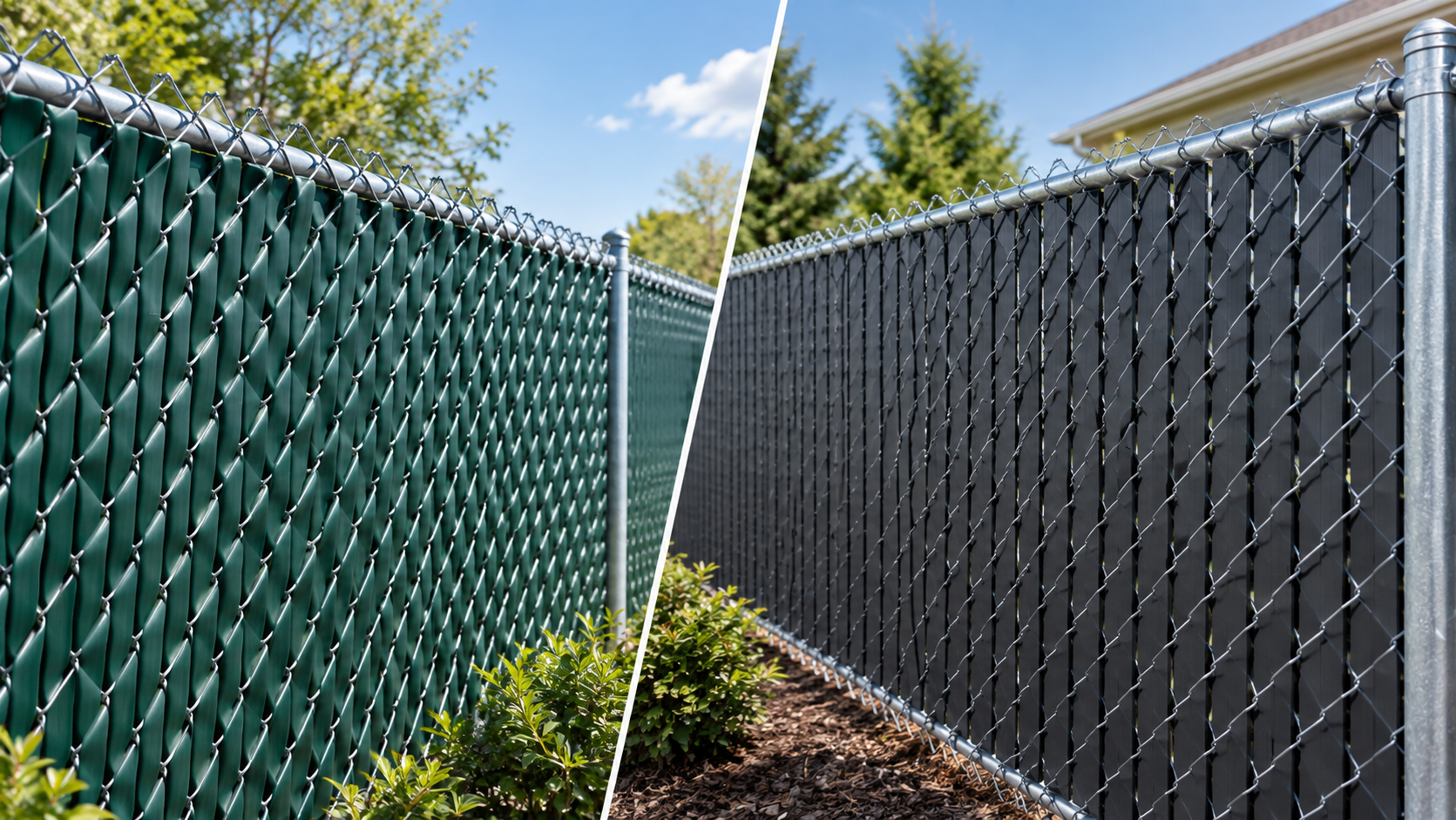
Contractors and distributors have a genuine choice to make on nearly every job: stick with traditional slats that get hand-stuffed on site, or move to a factory-inserted system like Noodle Link that arrives ready to install.
Understanding those differences helps dealers and contractors make the right call for each specific job rather than defaulting to whatever has always been done.
How Traditional Privacy Slats Work
Traditional privacy slats are shipped separately from the chain link fabric and inserted by hand, one at a time, once the fence is up. This method has been the industry standard for decades, and there is nothing wrong with the finished result when it is done correctly. A crew that knows what it is doing can produce a clean, even privacy fence using traditional slats.
The tradeoff is time. Hand stuffing slats is a slow, repetitive process, and on a long fence line it adds up to a significant number of labor hours that could otherwise be spent moving on to the next job. It also introduces more room for inconsistency, since spacing and tension depend on the attention of whoever is doing the stuffing that day, and that can vary from one crew member to the next.
How Noodle Link Changes the Process
Noodle Link takes the slat insertion step out of the field entirely. The slats are inserted at the factory before the product ever reaches the job site, so the chain link and the privacy slats arrive together as a single roll, ready to install. There is no stuffing, no separate materials to manage, and no extra step standing between unloading the truck and finishing the job.
For contractors, that translates directly into fewer labor hours per linear foot. For distributors, it means a simpler product to stock and sell, since Noodle Link eliminates a step that customers previously had to plan and budget for on their own.
Consistency Is Part of the Value
Beyond speed, factory insertion solves a quality control problem that hand stuffing cannot fully avoid. Because Noodle Link slats are inserted under controlled conditions at our facility in Smithfield, Utah, spacing and tension stay consistent across the entire roll. That consistency shows up in the finished fence line, which tends to look more uniform than a fence where slats were inserted by hand over the course of a long, tiring day.
For architects and specifiers writing specs that need to hold up across multiple phases of a large project, that kind of predictability is worth quite a bit. A fence installed in phase one should look the same as a fence installed in phase three, and factory insertion removes the variable of which crew member happened to be doing the stuffing on a given day.
When Traditional Slats Still Make Sense
Factory-inserted slats are not automatically the right choice for every job. Smaller residential projects with a short run of fence may not see enough labor savings to justify a different ordering process, particularly if a contractor already has traditional slats on hand from a previous job.
Some customers also have a strong preference for a specific slat style or locking system that is not yet available in a factory-inserted format, and matching customer expectations still matters more than pushing a newer product.
Our comparison of EZ Slats versus Ultimate Slats versus bottom locking slats is a useful resource for dealers trying to match a traditional slat style to a specific privacy percentage or wind load requirement, since not every job is purely a speed versus cost decision.
Making the Right Call for Your Next Job
The choice between Noodle Link and traditional privacy slats comes down to the specifics of the job in front of you. Large commercial installations, projects with tight timelines, and jobs where consistent appearance across a long fence line matters tend to favor factory-inserted slats. Smaller jobs, specific style requirements, or situations where materials are already on hand may still call for the traditional approach.
Reach out to PrivacyLink for product specifications, a side-by-side comparison, or help putting together a quote that accounts for both material and labor costs on your next job.
