


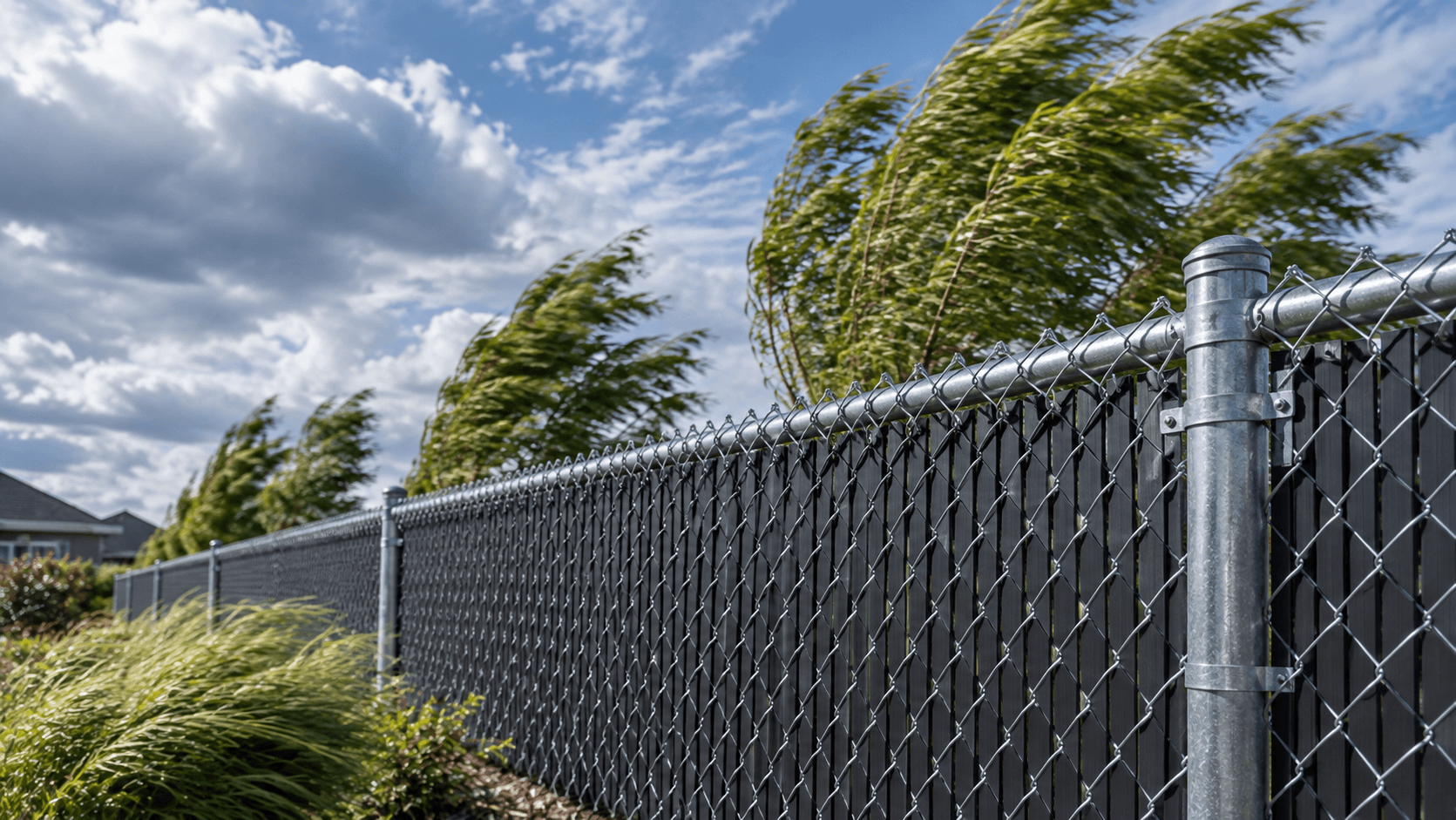
When a property owner asks for privacy chain-link fencing, factory inserts are often the most durable and cost-effective answer. However, adding privacy slats fundamentally alters the structural dynamics of a fence line. What was once an open, wind-permeable wire mesh transforms into a solid barrier that captures wind much like a sail on a ship.
For fence dealers, distributors, and contractors, recommending privacy slats in high-wind regions without evaluating the underlying framework is a risky proposition. Equipping your sales team with the technical knowledge surrounding wind load, post specifications, and product selection protects both your customer’s investment and your dealership’s reputation.
Understanding the “Sail Effect” and Wind Load Physics
Un-slatted chain link fabric typically boasts an open area of roughly 80% to 85%, allowing powerful wind gusts to pass through with minimal resistance. When high-density privacy slats are introduced, that open space drops drastically, providing anywhere from 75% to 98% sight blockage. That dramatic gain in privacy comes with a proportional increase in lateral wind resistance.
During severe storm events, high wind pressure acts directly against the surface of the slatted fabric. This force transfers immediately to the top rail, line posts, terminal posts, and concrete footings. If a lightweight residential fence is retrofitted with high-density slats, the structural load can easily exceed the yield strength of thin-wall tubing, resulting in bent posts, leaning fence lines, or total structural failure.
Engineering Specifications for High-Wind Applications
Preventing wind failure requires evaluating the entire fence assembly from the ground up. Before recommending or selling privacy slats, dealers must guide customers toward structural components engineered to handle elevated wind loads.
Post spacing and terminal post selection play a critical role in structural integrity. While standard residential chain link often utilizes 10-foot post centers, high-wind slatted installations frequently require shortening post spacing to 8-foot or even 6-foot centers to distribute lateral force effectively. Furthermore, heavy-wall pipe—such as Schedule 40 or high-yield structural tubing—is essential. Reviewing the commercial vs. residential chain link fencing key differences dealers should know allows your sales team to clearly explain why heavier wall thicknesses, larger post diameters, and deeper concrete footings are mandatory upgrades when transforming chain link into a privacy barrier.
Mesh size also impacts long-term performance. Smaller mesh openings combined with factory-inserted slats offer higher structural rigidity compared to wide-mesh field retrofits, preventing the slats from shifting, flexing, or rattling loose during high-velocity wind events.
Matching Slat Selection to Site Exposure
Not all privacy slats perform identically under stress. Recommending the right product involves balancing the client’s desire for total screening against the realistic wind exposure of the installation site.
For open terrain, coastal corridors, or elevated commercial zones, air-permeable or flexible winged slats offer an ideal balance. Winged slats utilize flexible side fins that provide up to 90% privacy while permitting minor air pressure relief, dampening the total force exerted on the fence posts. Alternatively, bottom-locking or top-locking rigid slats deliver exceptionally clean lines and maximum coverage, but they demand a fully rated commercial frame to withstand peak wind loads.
Material integrity is another decisive factor. Low-grade plastic slats quickly become brittle when exposed to solar UV rays and freezing temperatures, causing them to crack and shatter when subjected to wind-induced vibration. Recommending high-grade materials ensures long-term resilience. Knowing that PrivacyLink products are made in the USA gives dealers a powerful selling point, guaranteeing that the high-density polyethylene (HDPE) slats, color-matched wire, and factory-woven products are manufactured with premium UV inhibitors engineered to handle extreme atmospheric conditions without degrading.
Equipping Your Team with Winning Sales Arguments
When end-users question why a slatted fence quote requires heavier posts or deeper footings, your team has an opportunity to position themselves as trusted technical experts rather than simple order-takers.
Shift the conversation from upfront material cost to long-term value. Explaining that upgrading to a commercial-grade framework and factory-slatted fabric prevents catastrophic storm damage resonates strongly with commercial property managers and homeowners alike. Point to regional wind speed expectations and local building codes, demonstrating that your recommended specifications protect the installation against real-world weather patterns.
Partnering with PrivacyLink for High-Wind Solutions
Recommending privacy slats is one of the most effective ways for fence dealers to increase project margins and deliver functional, long-lasting screening solutions. However, long-term success depends on treating wind load as an integral part of the initial design process.
By pairing high-quality, domestically manufactured privacy products with properly engineered framework, your dealership can quote projects with complete confidence, eliminate costly warranty callbacks, and build a lasting reputation for quality. Contact the PrivacyLink team today to request technical spec sheets, product samples, or assistance with high-wind project quotes.
